Part I
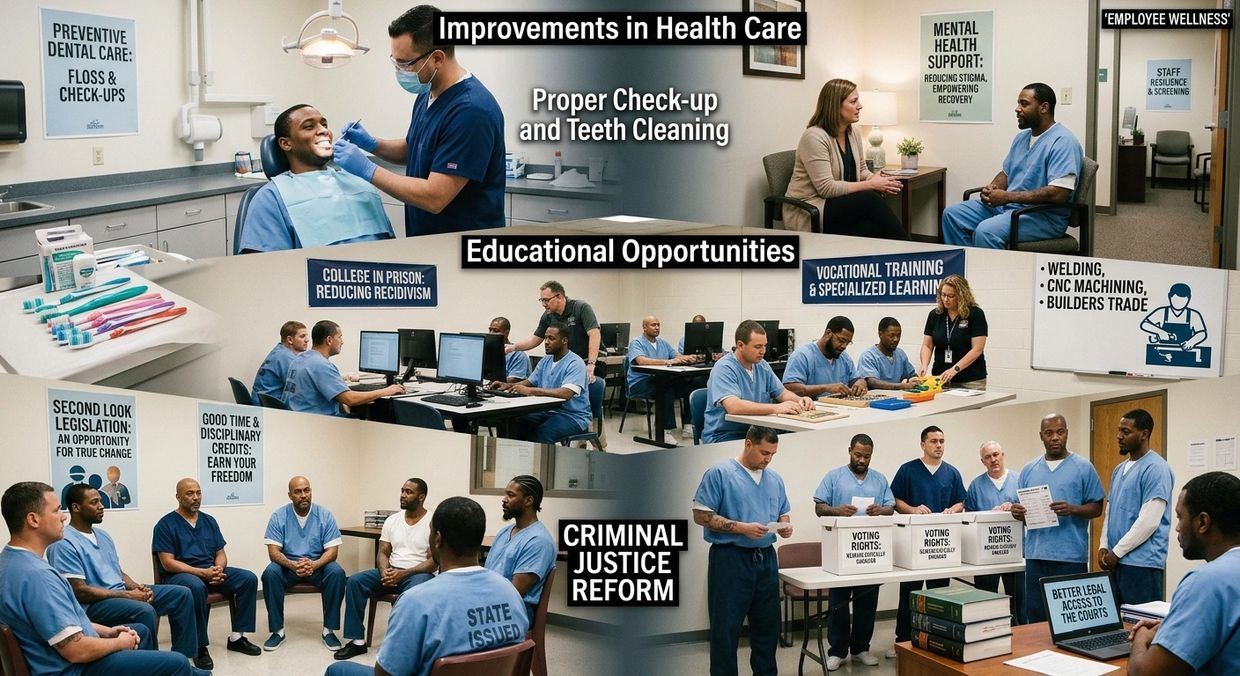
1.) Improvements in the Health Care that inmates receive. This includes dental and mental health.
* Dental Health: For decades the dental health department within the MDOC has taken the easiest and cheapest approach of simply yanking out inmates' teeth as opposed to providing proper services. Consequently, inmates are forced to rely on dentures or live with no teeth at all. Investing early in dental care will avoid having to exercise extreme measures. One such preventive act is the return of dental floss and proper toothbrushes to the commissary list.
* Mental Health: It is estimated that about 60% of the inmate population within the MDOC suffer from some form of mental illness and only 10% receive some form of assistance. Most inmates refuse any form of assistance for fear of being stigmatized and/or denied parole. In other words, these inmates would rather suffer alone than be subjected to shame or a lengthier prison sentences. In other instances, while most inmates entering prison are diagnosed with anti-social personality disorder they are left to fend for themselves. Unfortunately, many of these. inmates lack the proper coping skills and empathetic reactions and consequently spend most of their time in prison lashing out and catching infractions and at other times additional cases. At other times these same inmates are released to society with only a minimum of assistance that they received after being forced to participate in MDOC core programing like VPI, T4C, etc., only months prior to their release. A different approach must be taken if we are to ensure that inmates do not return to society and victimize again.
* MDOC Employee Mental Health: It has been statistically proven that correctional officers and other MDOC
employees suffer from mental health, which include an emergence in suicidal ideation. Without a proper approach to address this concern, correctional officers bring their problems to work and unleash them on the prison population adding to an already hostile environment. Michigan Department of Corrections needs a better screening process which will ensure that those obtaining employment will be mentality fit to cope with the stress required.
2.) Educational Opportunities:
A different approach to education within the MDOC if inmates are to prove successful and trust in their learning abilities. Inmates who struggle earning their GED are forced to sit in classrooms for years without actually improving their chances at receiving their GED. Some of these inmates suffer particular learning disabilities and yet are forced to sit in classrooms with other students who are proving successful in their educational endeavors. A different approach is required. Specific programs should be created that personally cater to these individuals. Absent this assistance they will find themselves locked out of the opportunities that are afforded to other inmates like college while in prison, participation in correspondence courses, and other opportunities. Statistics have shown that the further an inmate goes in college, the lesser the chances that he/she will recidivate. By these statistics it is almost 100% certain that those inmates with no education will return to prison. Of additional concern is the fact that while much has been invested in vocational programs like welding, Builders Trade, CNC Machine Shop, etc., for those inmates nearing their release, the MDOC should also consider returning vocational proper working routines, the inceptive of bonuses should be returned.
3.) Criminal Justice Reform:
Michigan is widely known for its notorious sentencing schemes. While crime in Michigan continuous to decrease, the amount of time inmates are forced to serve remain high. The logic in this is lost. Since it has been proven that people age out of crime, a serous look needs to be had for those inmates who have served lengthy prison sentences and proven themselves to be of no threat to society and therefore worthy of a second chance. A return to Second Look legislation, reimplementation of Good Time and the granting of disciplinary credits gives inmates incentives for true and lasting change. It is through these means that inmates can place themselves in positions that can reward their positive behavior with a new sentence that will give them the opportunity to return to their families and society.
* Voting Rights: Once released inmates, even while on parole, regain their right to vote. It is our position that this right should be restored while inmates remain in prison. This will ensure that inmates remain civically engaged. There are several states that have returned this right to their incarcerated population and Michigan should join this block.
* Better Legal Representation and Access to the Courts: For decades it has been known that inmates receive poor and inadequate assistance when it comes to redressing the courts. Moreover, many inmates, having full distrust on the legal system, feel the need to plead out their cases and are ushered into prison with long and indeterminate sentences; sentences they may not have received had they taken their case to trial. Upon entering prison they are left alone to navigate the complexities of the judicial system. Many of these needs could be minimized if inmates are given better legal representations and easier access to the courts.
* Implementation of Good Time and Disciplinary Credits: It has been widely known that when given the
opportunity to do less prison time, inmates will work toward that end. Currently there are no incentives to motivate many inmates to pursue a change in lifestyle and consequently, they either resort to prior negative behavior or remain in the same destructive path. Prior to the "tough on crime" and "lock 'em up and throw away the key” philosophies that were embraced by our political leaders, Michigan offered its inmates a chance at early release. By participating in rehabilitative programs, maintaining good prison reports, and living productively, inmates worked at showing their ability to change. With the disappearance of Good Time and the opportunity to gain disciplinary credits, inmates are stuck until their earliest release date, some of these ERDs being decades into the future. By the time most of these inmates are released they are much too old to contribute to society and must then seek out assistance with every facet of living including housing and health care. A return to Good Time and Disciplinary Credits is a logical solution for inmates to earn their freedom.
Part II
4.) Security Threat Groups Policy:
The MDOC has adopted the means of dealing with its security groups strictly with disciplinary measures. While it is understood, to some degree, the need for such policy, this approach contradicts the MDOC's recent approach to incarceration. Many inmates classified under the STG policy have remained thus classified even though their behavior has changed for the better. For others, there is a hopelessness that no matter what changes they institute, the MDOC will maintain the STG status. Consequently, many continue to use creative ways to circumvent their status. A revamping of the policy and approach should be taken where inmates who have proven themselves are rewarded with incentives until their status is returned and where they can rejoin their fellow inmates in working towards rehabilitation.
5.) Covid-19 brought about many changes both beneficial and detrimental. The restrictions to inmates' visiting schedules has been a detrimental change. Prior to Covid-19 inmates received more time for visiting with their loved ones. They were allowed to receive visits from their family without having to submit to a schedule and time constraints. For decades the MDOC operated under this fashion until the pandemic. Such restrictions have only served the opposite effect than the security of the facility. Statistically speaking, inmates who have contact with their loved ones have proven to remain in society longer. If this is true, then what would the hindrance of visit produce?
6.) Technological Advancement:
While county jails across the state of Michigan have implemented programs whereby their prisoner population are given tablets with outside calling capabilities, access to educational programs and entertainment, the MDOC remains pushing outdated technology. Having such abilities will cut back on the inmate-to-inmate violence over the phone system, will ensure that inmates continue to evolve educationally and allow for inmates to have the know how with technology as they return to society.
7.) Better Food Quality:
Michigan inmates suffer from preventable diseases in part because of the food quality they ingest. It is widely known but seldomly acknowledged publicly that Michigan prisoners are served poor quality food. Food that is largely processed and saturated with unhealthy fats. Consequently inmates are facing an increase in diabetes and high blood pressure. And while some inmates turn to the commissary in an attempt to supplement what they aren’t being properly served, there again the food items sold prove no different. One company has cornered the MDOC market selling whatever unhealthy item they desire at whatever price they see fit, all to the detriment of the inmate population and their family, most of whom cannot afford to send their incarcerated family member the $100-$200 a month that would take to sustain them while incarcerated. Opening the bidding process to allow for better opportunities for the introduction of healthier food to be served and sold is an approach that we will pursue.
8.) Inmate Pay Scale:
We all have watched as the price of living increases while the pay received remains stagnant. While many in the outside world are being introduced to this reality, the inmate population within the MDOC has been forced to live it for decades. Price increase on the items purchased through commissary, health care copay, and other requirements force inmates to purchase less healthier items; items that further their chances at becoming victims of preventable diseases. To purchase the few "healthier" items the inmate must choose between quality over quantity, with that quality taking the lion's share of his/her monthly pay. In order to offset the increased price of living, inmates must be paid a proper wager. Therefore, to do away with the stagnant pay scale we are seeking an increase of 50-60 percent. This is to include those inmates who are forced to participate on the indigency program. In addition, we will pursue a change in policy where an inmate's family will be allowed to purchase additional items,
i.e., clothing, appliances, etc., in order to offset the cost to the inmate and the meagre pay they receive.

Part III
9.) Opening of Bids:
For years to inmate population has served as a cash cow for many companies who have lined their pockets with our families' hard earned money. Knowing that our family want to best for us, these companies have steadily increased prices at will and ignored the true needs of the inmate population. In order to fight off the monopolization of these companies, we will pursue open bids with various companies and insure that the interest of the inmate